5 Reasons to Pick In-House Printing Over Outsourced Printing
Despite the paperless focus of our digital age, it’s a simple fact: printing is a major building block of most businesses, and it will probably continue to be for many years to come. According to Print is Big, “45 trillion pages are printed annually,” the thriving print industry is worth a whopping “$640 billion,” and direct mail promotion (in print) brings in billions of dollars in sales every year. Printing expenditures are a major corporate cost, usually following only office space fees and employee paychecks.
This activity and related operations are also likely a key component of your company’s workflow, so it behooves you to understand how they work and optimize their efficiency.
When it comes to taking charge of your printing, you’ll have to decide: is in-house or outsourced better for you? With in-house printing, you’d manage, coordinate, and process your documents using your very own equipment within the walls of your office. In contrast, outsourced printing involves sending your files to an independent business that uses its own fleet of machinery to print your documents and send them back to you. At Kelley Create, we’ve spent more than four decades helping businesses do better with the right office technology. While outsourcing has some apparent benefits, we’ve seen the numerous advantages of printing for yourself. In the following blog, we cover the top five reasons to pick in-house printing over outsourced options.
It’s better for the environment
When handled incorrectly, printing can be quite damaging to the environment. Every page wasted contributes to global deforestation and other ecological issues. Outsourced printing can lead to excessive waste and use of resources. In his article, “Better to Print In-House or Outsource?,” The DocuMentor describes: “when a job is outsourced to a third party, the customer typically prints up to 20 percent more copies than they actually need, either to get a better price or to make sure they are covered should the need for more copies arise. These ‘extra’ copies tend to get thrown away eventually, representing quite a bit of lost profits and efficiency,” as well as contributing unnecessarily to environmental concerns. The DocuMentor urges businesses to consider: “what…about the environmental impact of your decision?”
Furthermore, when you work with an outsourced printer, you can’t be sure if the company is using the most efficient or environmentally friendly equipment. The old adage “if you want something done right, do it yourself” certainly applies in this instance. When you opt for in-house printing, you can select more sustainable technology and techniques. For example, the Kelley Create team has a variety of programs your office can participate in to go green. We often advocate for pre-owned equipment and Toshiba’s erasable toner copier for an environmental upgrade.
In-house printing is typically more secure
Confidentiality is also a concern when it comes to outsourcing. If your company ever needs to print private information (legal documents, invoices, bills, etc.), sending it to a third party might not be worth the risk. Graphic Arts Magazine explains: “one reason for in-house printing services is the need for security…it is easier to maintain liabilities if all the work is done by company employees.” The magazine goes on to point out that “key card printing” could pose a problem if employee IDs are lost or stolen, while “transactional data printing” might open up clients’ financial information to theft. In-house printing keeps your documentation under your roof so you can safeguard it better.
You won’t have to wait around for shipping
An inherent aspect of outsourced printing is shipping. While you can send digital files to provide the information that needs to be printed, once the work is actually done, the company will need to send them back to you in physical form. This inevitably adds time, hassle, and potential logistical issues to the process, which could be particularly troublesome if you’re dealing with a tight deadline or (heaven forbid) find a typo in one of your documents.
In-house printing technology has become more advanced
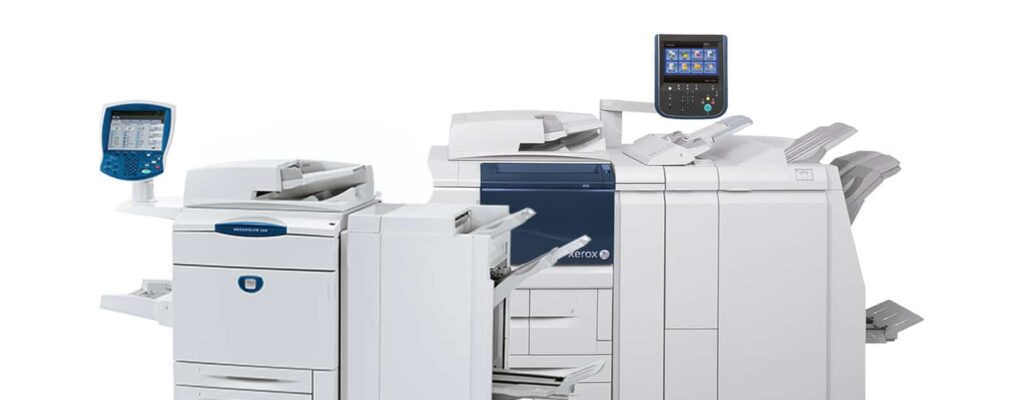
In the past, outsourcing your printing was the only way to leverage more sophisticated (and therefore quite expensive) technology. However, in recent years, this equipment has become much more accessible and affordable. You can now bring the speed, precision, and power of printing into your own office environment.
In addition to being able to manage print services and mobile print solutions, you can also take advantage of the latest and greatest advancements in printing without having to utilize a third party provider.
You have greater control over your documents
The primary perk of in-house printing is control. Investing in your own equipment and managing your documentation directly can give you greater authority over your schedule, design, costs, and more. For example, when it comes to printed promotional materials, Graphic Arts Magazine notes: “having one team work on your brand as opposed to dispersing it across many vendors can make the output more consistent.” Similarly, Xerox explains: “when you take printing in-house you gain control of the print queue and priorities.” This allows you to decide which documents to put first and masterfully manage myriad client requests on a day-to-day basis. Most business owners and office managers would like to have a more hands-on approach to printing, and in-house systems provide just that.